The compassion and mercy of Islam not only encompasses humanity, but also extends to all creatures in the world.
by IslamReligion.com
http://www.islamreligion.com/articles/185/
God, the Creator of human beings and animals, has made animals subservient to us. We depend on animals for the food we eat and the milk we drink. We bring animals into our homes for love and companionship. We survive critical illness and live longer because of biomedical research on animals. We visit to zoos and aquariums to gain an appreciation for the spectacular diversity of life on earth. We benefit from specially trained dogs that detect drugs, guide the blind, and assist the disabled. God says in the Quran: “And the cattle, He has created them for you. You have in them warm clothing and (other) advantages, and of them you eat. And therein is beauty for you, when you drive them back (home) and when you send them out (to pasture). And they carry your heavy loads to regions which you could not reach but with great distress to yourselves. Surely your Lord is Compassionate, Merciful. And (He made) horses and mules and asses that you might ride upon them and as an ornament. And He creates what you know not.” (Quran 16:5-8)
The mercy of Islam extends beyond human beings to all living creations of God. Islam prohibits cruelty to animals. Fourteen hundred years ago, long before the modern animal rights movement began with the publication of Peter Singer’s book, “Animal Liberation,” in 1975, Islam required kindness to animals and cruelty to them a sufficient reason for a person to be thrown into the Fire!
Once, the Prophet of Mercy spoke of God’s forgiveness due to the humane treatment of animals. He told his companions the story of a man who got thirsty on his way. He found a well, climbed down inside it to the water, and quenched his thirst. When he came out he saw a panting dog licking on mud out of extreme thirst. The man thought to himself, ‘The dog has become as thirsty as I was!’ The man went down the well again and got some water for the dog. God appreciated his good work and forgave him. The companions asked, ‘O Prophet of God, do we get rewarded on humane treatment of animals?’ He said, ‘There is a reward in (doing good to) every living being.’[1]
On another occasion, Prophet Muhammad, may the mercy and blessings of God be upon him, described God’s punishment of a woman who was sent to Hell because of a cat. She kept her locked up, neither feeding her nor setting her free to feed herself.[2]
Islam laid down humane slaughtering regulations. Islam insists that the manner of slaughter should be that which is least painful to the animal. Islam requires that the slaughtering instrument not be sharpened in front of the animal. Islam also prohibits the slaughtering of one animal in front of another. Never, prior to Islam, had the world witnessed such concern for animals.
Humane Islamic treatment of animals can be summarized by the following points:
First, Islam requires that pets or farm animals be provided with proper food, water, and a place to live. Once the Prophet passed by an emaciated camel due to hunger, he said: “Fear God in regards to these animals who cannot speak their will. If you ride them, treat them accordingly (by making them strong and fit for that), and if you [plan to] eat them, treat them accordingly (by making them fat and healthy).” (Abu Dawud)
Second, an animal should not be beaten or tortured. Once the Prophet of Mercy passed by an animal branded on his face. He said, ‘Has it not reached you that I have cursed the one who brands an animal’s face or hits it on its face?’[3] The Prophet of Mercy advised his wife to treat an unruly camel that she was riding kindly.[4] Making animals fight one another for entertainment was also forbidden by the Prophet.[5]
Third, Islam forbids using animals or birds for targets when practicing shooting. When Ibn Umar, one of the companions of Prophet Muhammad saw some people practicing archery using a hen as a target, he said: “The Prophet cursed anyone who made a living thing into a target (for practice).”
The Prophet Muhammad also said: “‘Whoever kills a bird or anything else without its due right, God would ask him about it.’ It was said: ‘O Messenger of God! What is its due right?’ He said: ‘To kill it for food…and do not sever its head, and throw it!’” (Targheeb)
Shooting at live pigeons was once an Olympic event and today dove shooting is allowed in many places.
Fourth, separating nestling birds from their mothers is not allowed in Islam.
Fifth, it is forbidden to mutilate an animal by cutting off its ears, tails or other body parts without just reason.
Sixth, a sick animal under one’s care should be treated properly.
Through these rules and regulations legislated in regards to animals, the Muslims gains the respect and understanding that other creatures are not to be used and abused as one wills, but that they, like humans, have rights which must be given in order to ensure that the justice and mercy of Islam be met to all which inhabit this earth.
Footnotes:
[1] Saheeh Al-Bukhari
[2] Saheeh Al-Bukhari
[3] Abu Dawud, Saheeh Muslim
[4] Saheeh Muslim
[5] Abu Dawud, Al-Tirmidhi
Saturday, June 27, 2009

The Creation of an Environmental Conscience (part 3 of 4): Animal Rights and Wrongs
The ethical treatment of animals in Islam; from the Quran and authentic narrations of the Prophet Muhammad.
by Ben Adam
http://www.islamreligion.com/articles/361/
“God has created every moving (living) creature from water. Of them there are some that creep on their bellies, some that walk on two legs, and some that walk on four. God creates what He wills. Verily! God is Able to do all things.” (Quran 24:45)
Throughout the revealed texts of Islam, we find that God has animals playing not insignificant roles in the fate of nations. After all, in the above verse we are informed of our common origin: water.
In the story of the People of Thamud, for example, we are given an indication of Islam’s enforcing of ethical treatment of animals, or more precisely, the severe consequences of mistreating them. For it was only after Thamud slaughtered the she-camel miraculously sent to them by God as a Sign, after they had already oppressed the beast by denying her water to drink, that God destroyed the nation in one single mighty blast.[1]
“(The People of) Thamud denied (their Prophet, Salih) through their transgression, when the most wicked man among them went forth (to kill the she-camel). But the Messenger of God (Prophet Salih) (had) said to them: Be cautious! That is the she-camel of God! (So do not harm it) and bar it not from having its drink (of water)! Then they denied him and they killed it. So their Lord destroyed them because of their sin, and made them equal in destruction!” (Quran 91:11-4)
In order to best appreciate just how seriously Islam champions what in modern times are popularly referred to as “animal rights”, and how seriously Islam criminalizes any wrong done to animals, one need venture no further than the authentic narrations (ar. ahadith) of the Prophet Muhammad. No detailed commentary will be necessary as the words of the Prophet, often highly charged with emotion and empathy for the suffering of birds and beasts alike, speak loudly for themselves as they vividly illustrate Islam’s unprecedented “humanistic” regard for man’s fellow creatures. From amongst the many sayings of the Prophet Muhammad are:
“Whilst a man was walking on a road, he was overcome with severe thirst. So he found a well, descended into it, drank (his fill), and then came out. Then he saw a dog panting hard and eating the moist earth. So he said: ‘Verily, this dog is overcome with thirst like I had been.’ So he (again) descended into the well and filled his leather socks with water. Grasping his socks in his mouth, he came out of the well and then quenched the dog’s thirst. Therefore, God thanked the man and forgave him his sins.” The Companions asked: ‘O Messenger of God! Do we really get reward for (being kind even to) animals?’ The Prophet replied: ‘There is reward for (showing kindness to) every living thing.’” (Saheeh Al-Bukhari, Saheeh Muslim, Abu Dawood)
“A woman was punished on account of a cat. She imprisoned it until it died, so was entered into Hellfire. She neither fed it nor quenched its thirst whilst she held it captive, nor did she leave it be to eat from the insects of the earth.” (Saheeh Al-Bukhari, Saheeh Muslim, Ibn Majah)
“Whoever kills [even] a sparrow without good reason, God will question him about it on the Day of Resurrection.” (Ahmed)
“Do not use living creatures for target practice.” (Saheeh Muslim)
“An earlier Prophet of God was stung by an ant and so, in anger, ordered the entire ants nest be burned. At this, God reprimanded this Prophet with the words: ‘Because one ant stung you, you have burned a whole community which glorified Me.’” (Saheeh Al-Bukhari, Saheeh Muslim)
“The one to whom his horse is a source of reward is the one who keeps it in the path of God, and ties it by a long rope in a pasture or a garden. Such a person will get a reward equal to what the horse’s long rope allows it to eat in the pasture or the garden. And if the horse breaks its rope and crosses one or two hills, then all marks of its hoofs and its dung will be counted as good deeds for its owner. And if it passes by a river and drinks from it, then that will also be regarded as a good deed on the part of its owner.” (Saheeh Al-Bukhari)
“Do not clip the forelock of a horse, for decency is attached to its forelock; nor its mane, for it protects it; nor its tail, for it is its fly-swatter.” (Abu Dawud)
“While a man was riding a cow, it turned toward him and said: ‘I have not been created for this purpose; I have been created for plowing.’” (Saheeh Al-Bukhari)
Abdullah bin Abbas narrated: “God’s Messenger forbade inciting animals to fight each other.” (Saheeh Al-Bukhari, Saheeh Muslim, at-Tirmidhi)
Abdur-Rahman bin Abdullah bin Mas‘ud narrated: “We were on a journey with the Messenger of God, and he left us for a while. During his absence, we saw a bird called Hummara with its two young and so we took the young ones. The mother bird was circling above us in the air, beating its wings in grief, when the Prophet came back and said: ‘Who has hurt the feelings of this bird by taking its young? Return them to her!’” (Saheeh Muslim)
Jabir bin Abdullah narrated that the Prophet, upon seeing an ass which had been branded in its face pass him by, became so upset that he exclaimed: “May God curse the one who branded it.” (Saheeh Muslim)
The Prophet’s wife, A’isha, narrated: “I was riding a restive camel and turned it rather roughly. The Prophet said to me: ‘It behooves you to treat animals gently.’” (Saheeh Muslim)
Yahya bin Said narrated: “The Prophet was seen wiping the face of his horse with his gown. When asked why he was doing that, he replied: ‘Last night I was reprimanded by God for having neglected my horse.’” (Muwatta)
Abdullah bin Ja’far mentioned that when the Prophet passed by some children who were shooting arrows at a ram, he rebuked them, saying: “Do not maim the poor beast.” (an-Nasai)
Even a cursory reading of the Prophet’s words above will have revealed how harming, abusing or disfiguring animals carries stern censure in this world and severe penalty in the Hereafter; while protecting animals and showing mercy and kindness to them is rewarded by God, a path to forgiveness, and expiation of one’s sins. It is clear also that Islam acknowledges the pain and suffering felt and experienced by animals – both physical and psychological - and how they instinctively recognize when injustice is done to them. Quite remarkably, Islam also recognizes animals as possessing a conscience, natural dignity, and even unique individual identities (a bird named “Hummara”, a donkey named “Uqayr”, and so on).
“And the earth He has put for the living creatures. Therein are fruits and palms producing sheathed fruit-stalks; and also corn, with (its) leaves and stalks for fodder, and sweet-scented plants. Then which of the Blessings of your Lord will you deny?” (Quran 10:10-13)
Footnotes:
[1] The destruction of the She-Camel in itself is not the reason God destroyed the nation. Rather, it is the destruction of His Special Sign which had been sent to them, such destruction symbolizing their utter denial of God as the One to whom they will return, and Tawheed as the religion that he ordained. Similarly, when a man hurts any animal without just cause, he is denying one of the aspects God has ordained mankind should act on, which is mercy. When a man denies an animal (or vegetation) its right to mercy, then the right to mercy the man has from God is similarly withdrawn, and he will be punished. Furthermore, if a man intentionally performs a mercy to an animal, vegetation (or person), then God will reward him out of His mercy.
by Ben Adam
http://www.islamreligion.com/articles/361/
“God has created every moving (living) creature from water. Of them there are some that creep on their bellies, some that walk on two legs, and some that walk on four. God creates what He wills. Verily! God is Able to do all things.” (Quran 24:45)
Throughout the revealed texts of Islam, we find that God has animals playing not insignificant roles in the fate of nations. After all, in the above verse we are informed of our common origin: water.
In the story of the People of Thamud, for example, we are given an indication of Islam’s enforcing of ethical treatment of animals, or more precisely, the severe consequences of mistreating them. For it was only after Thamud slaughtered the she-camel miraculously sent to them by God as a Sign, after they had already oppressed the beast by denying her water to drink, that God destroyed the nation in one single mighty blast.[1]
“(The People of) Thamud denied (their Prophet, Salih) through their transgression, when the most wicked man among them went forth (to kill the she-camel). But the Messenger of God (Prophet Salih) (had) said to them: Be cautious! That is the she-camel of God! (So do not harm it) and bar it not from having its drink (of water)! Then they denied him and they killed it. So their Lord destroyed them because of their sin, and made them equal in destruction!” (Quran 91:11-4)
In order to best appreciate just how seriously Islam champions what in modern times are popularly referred to as “animal rights”, and how seriously Islam criminalizes any wrong done to animals, one need venture no further than the authentic narrations (ar. ahadith) of the Prophet Muhammad. No detailed commentary will be necessary as the words of the Prophet, often highly charged with emotion and empathy for the suffering of birds and beasts alike, speak loudly for themselves as they vividly illustrate Islam’s unprecedented “humanistic” regard for man’s fellow creatures. From amongst the many sayings of the Prophet Muhammad are:
“Whilst a man was walking on a road, he was overcome with severe thirst. So he found a well, descended into it, drank (his fill), and then came out. Then he saw a dog panting hard and eating the moist earth. So he said: ‘Verily, this dog is overcome with thirst like I had been.’ So he (again) descended into the well and filled his leather socks with water. Grasping his socks in his mouth, he came out of the well and then quenched the dog’s thirst. Therefore, God thanked the man and forgave him his sins.” The Companions asked: ‘O Messenger of God! Do we really get reward for (being kind even to) animals?’ The Prophet replied: ‘There is reward for (showing kindness to) every living thing.’” (Saheeh Al-Bukhari, Saheeh Muslim, Abu Dawood)
“A woman was punished on account of a cat. She imprisoned it until it died, so was entered into Hellfire. She neither fed it nor quenched its thirst whilst she held it captive, nor did she leave it be to eat from the insects of the earth.” (Saheeh Al-Bukhari, Saheeh Muslim, Ibn Majah)
“Whoever kills [even] a sparrow without good reason, God will question him about it on the Day of Resurrection.” (Ahmed)
“Do not use living creatures for target practice.” (Saheeh Muslim)
“An earlier Prophet of God was stung by an ant and so, in anger, ordered the entire ants nest be burned. At this, God reprimanded this Prophet with the words: ‘Because one ant stung you, you have burned a whole community which glorified Me.’” (Saheeh Al-Bukhari, Saheeh Muslim)
“The one to whom his horse is a source of reward is the one who keeps it in the path of God, and ties it by a long rope in a pasture or a garden. Such a person will get a reward equal to what the horse’s long rope allows it to eat in the pasture or the garden. And if the horse breaks its rope and crosses one or two hills, then all marks of its hoofs and its dung will be counted as good deeds for its owner. And if it passes by a river and drinks from it, then that will also be regarded as a good deed on the part of its owner.” (Saheeh Al-Bukhari)
“Do not clip the forelock of a horse, for decency is attached to its forelock; nor its mane, for it protects it; nor its tail, for it is its fly-swatter.” (Abu Dawud)
“While a man was riding a cow, it turned toward him and said: ‘I have not been created for this purpose; I have been created for plowing.’” (Saheeh Al-Bukhari)
Abdullah bin Abbas narrated: “God’s Messenger forbade inciting animals to fight each other.” (Saheeh Al-Bukhari, Saheeh Muslim, at-Tirmidhi)
Abdur-Rahman bin Abdullah bin Mas‘ud narrated: “We were on a journey with the Messenger of God, and he left us for a while. During his absence, we saw a bird called Hummara with its two young and so we took the young ones. The mother bird was circling above us in the air, beating its wings in grief, when the Prophet came back and said: ‘Who has hurt the feelings of this bird by taking its young? Return them to her!’” (Saheeh Muslim)
Jabir bin Abdullah narrated that the Prophet, upon seeing an ass which had been branded in its face pass him by, became so upset that he exclaimed: “May God curse the one who branded it.” (Saheeh Muslim)
The Prophet’s wife, A’isha, narrated: “I was riding a restive camel and turned it rather roughly. The Prophet said to me: ‘It behooves you to treat animals gently.’” (Saheeh Muslim)
Yahya bin Said narrated: “The Prophet was seen wiping the face of his horse with his gown. When asked why he was doing that, he replied: ‘Last night I was reprimanded by God for having neglected my horse.’” (Muwatta)
Abdullah bin Ja’far mentioned that when the Prophet passed by some children who were shooting arrows at a ram, he rebuked them, saying: “Do not maim the poor beast.” (an-Nasai)
Even a cursory reading of the Prophet’s words above will have revealed how harming, abusing or disfiguring animals carries stern censure in this world and severe penalty in the Hereafter; while protecting animals and showing mercy and kindness to them is rewarded by God, a path to forgiveness, and expiation of one’s sins. It is clear also that Islam acknowledges the pain and suffering felt and experienced by animals – both physical and psychological - and how they instinctively recognize when injustice is done to them. Quite remarkably, Islam also recognizes animals as possessing a conscience, natural dignity, and even unique individual identities (a bird named “Hummara”, a donkey named “Uqayr”, and so on).
“And the earth He has put for the living creatures. Therein are fruits and palms producing sheathed fruit-stalks; and also corn, with (its) leaves and stalks for fodder, and sweet-scented plants. Then which of the Blessings of your Lord will you deny?” (Quran 10:10-13)
Footnotes:
[1] The destruction of the She-Camel in itself is not the reason God destroyed the nation. Rather, it is the destruction of His Special Sign which had been sent to them, such destruction symbolizing their utter denial of God as the One to whom they will return, and Tawheed as the religion that he ordained. Similarly, when a man hurts any animal without just cause, he is denying one of the aspects God has ordained mankind should act on, which is mercy. When a man denies an animal (or vegetation) its right to mercy, then the right to mercy the man has from God is similarly withdrawn, and he will be punished. Furthermore, if a man intentionally performs a mercy to an animal, vegetation (or person), then God will reward him out of His mercy.
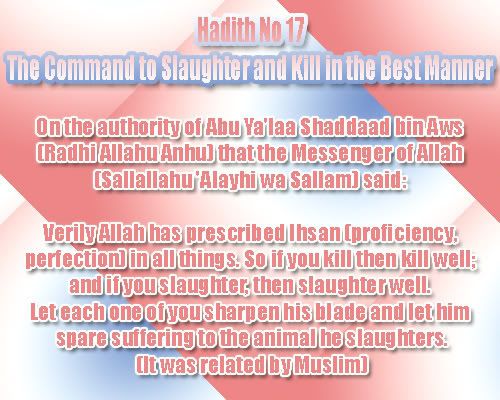
Hadith #17- The concept of Ihsan
http://fortyhadith.iiu.edu.my/hadith17.htm
*~*~*~*~*~*~*~*~*~*~*
Background
Ihsan is a comprehensive concept. It denotes doing things completely, nicely and in a tasteful manner. It comprises four components:
1. Sincerity (Ikhlas)
2. Completeness
3. Tastefulness (doing things in a nice manner), and
4. Correctness (doing things in the right way).
This concept is translated by commentators and interpreters as Excellence. Being a comprehensive concept, the term Ihsan cannot be translated word for word because there is no word in the English language that gives its exact meaning. Therefore, it is better to use it as it is.
Islam commands Muslims to practice and apply Ihsan in all that they do - hence it is an obligation (wajib).
It has been mentioned in the Qur’an as well. Allah the Almighty says: "Verily, Allah enjoins Justice, and Ihsan and giving help to kith and kin,..." [Surah Al-Nahl (16 ): ayat 90]
In Surah Al-Mulk (67), ayat 2 this concept is mentioned as one of two main purposes of human creation, Allah the Almighty says: "The One Who created death and life so that He may test you which of you is best of conduct."
Lessons
The hadith contains a principle and provides an example of applying that principle. This is a Prophetic method, as mentioned previously, to enable Muslims to apply the same principle to other similar situations. It can also be said that providing the example is a way of explaining the principle so it is easily understood. Most of the forty hadiths collected by Imam Nawawi are of this nature. It was also previously mentioned that Muslims have a tendency of taking the example and forgetting about the principle. This may explain why Muslims are reminded of this hadith only once a year, during Eid ul-Adha.
The concept of Ihsan means that a Muslim is a responsible person and a person of quality where he does things in a very good manner, in a complete sense, in a nice and tasteful way and is never satisfied with anything other than a quality job in all that he/she does, motivated by realizing that Allah prescribed Ihsan to everything and to all deeds.
The term ‘amalan in its selected form as mentioned in Surat Al-Mulk ayat 2 implies any kind of deeds. It is not just the religious deeds (ibadah), but also all that we do which is lawful. It should be done according to the concept of Ihsan and we should exert our efforts to live up according to its implications. The way we look and dress, the way we eat, the way we sleep, our work, our profession, our da’wah, teaching and learning, our relationship with our family, relatives, neighbors, and with others in general - Ihsan should be observed and practiced in all these actions. These actions and good deeds can be considered as ibadah thereof.
The superlative form of the verb used in the same verse (ahsan) implies that all good deeds and actions that we do should be done in a competitive way. However, competition in Islam is not for achieving personal interest but rather for seeking the pleasure of Allah.
The hadith mentions one way of dealing nicely or being merciful with animals and that is in the case of slaughtering. In another hadith the Prophet, sallallahu 'alayhi wasallam, said: “Whoever shows mercy even when slaughtering a bird, Allah will have mercy on him on the Day of Judgment.” [Recorded by Al-Bukhari]
In another hadith, the Prophet, sallallahu 'alayhi wasallam, related this story: “While a man was traveling, he felt very thirsty. He found a well and went down to have a drink. When he came out he found a thirsty dog. He said to himself, "This dog is as thirsty as I was." He then went back inside the well and used his shoe to bring out some water for the dog. Allah was pleased with him and forgave his sins because of what he had done." [Recorded by Al-Bukhari]
In other hadiths the Prophet, sallallahu 'alayhi wasallam, warns us not to frighten animals. While he was with his companions he found a bird making a grieving sound. The Prophet, sallallahu 'alayhi wasallam, immediately said: “Who has frightened this bird by taking its offspring?” Then he commanded: “Return back her offspring.” In another hadith the Prophet, sallallahu 'alayhi wasallam, warned Muslims not to harm animals. He said: “A lady was put into the hellfire because of a cat. She tied up the cat and did not give her anything to eat nor did she allow it to look for food.”
One more ruling concerning dealing nicely with animals is not to abuse the animals we use for achieving certain work (i.e. carrying things) and not to overburden them. In one hadith (which shows a prophetic miracle), the Prophet, sallallahu 'alayhi wasallam, was passing by a farm in Maddinah when he came across a camel. The camel approached the Prophet, sallallahu 'alayhi wasallam, as if it was telling him something. The Prophet, sallallahu 'alayhi wasallam, asked about the owner of the camel and called upon him and told him, “Your camel is complaining that you overburden him with work, and gives him too little to eat.” [Narrated by Abu Daud, Al-Hakim, Imam Ahmad, and others and it is an authentic hadith]
Shaykh Abdullah bin Jibrin, a contemporary scholar, is in the view that animals should not be used as a testing instrument in the lab (like what is being done in the West) based on a basic ruling derived from this Hadith 17, where it is prohibited to harm an animal. The testing is only allowed if it can be ensured that the animal will not be harmed. All this shows that Islam is the religion of Ihsan and mercy, which is totally contrary to the image of Islam being promoted in the West. Not only that, but this evidently proves that the West are the ones who abuse and harm animals.
Even in Jihad (fighting enemies), Muslims are to apply Ihsan. We are not allowed to kill the elders, children, women, and those who are not fighting. When killing the aggressive enemy who deserves to be killed, Ihsan has to be applied and observed. We have to make sure not to cause any harm or suffering to anyone we kill. The captives have to be treated with Ihsan as well. It is Islam who introduced a new way of dealing with captives. We are to free them on the basis of them teaching some Muslims something beneficial.
Weapons that cause mass destruction have been initiated, introduced and used by the West. Using them contradicts with the concept of Ihsan. But how about if the enemies of Islam use them against us? Some cotemporary scholars say that Muslims are allowed to use them only in response and as a counter act.
Conclusion
By living according to the concept of Ihsan and by applying it to all that a Muslim does, he/she will be rewarded and showered with mercy and forgiveness from Allah the Almighty. Furthermore, by doing that, a Muslim will ensure that he/she will pass the test and be amongst those of the best conduct.
Ihsan is a comprehensive concept. It denotes doing things completely, nicely and in a tasteful manner. It comprises four components:
1. Sincerity (Ikhlas)
2. Completeness
3. Tastefulness (doing things in a nice manner), and
4. Correctness (doing things in the right way).
This concept is translated by commentators and interpreters as Excellence. Being a comprehensive concept, the term Ihsan cannot be translated word for word because there is no word in the English language that gives its exact meaning. Therefore, it is better to use it as it is.
Islam commands Muslims to practice and apply Ihsan in all that they do - hence it is an obligation (wajib).
It has been mentioned in the Qur’an as well. Allah the Almighty says: "Verily, Allah enjoins Justice, and Ihsan and giving help to kith and kin,..." [Surah Al-Nahl (16 ): ayat 90]
In Surah Al-Mulk (67), ayat 2 this concept is mentioned as one of two main purposes of human creation, Allah the Almighty says: "The One Who created death and life so that He may test you which of you is best of conduct."
Lessons
The hadith contains a principle and provides an example of applying that principle. This is a Prophetic method, as mentioned previously, to enable Muslims to apply the same principle to other similar situations. It can also be said that providing the example is a way of explaining the principle so it is easily understood. Most of the forty hadiths collected by Imam Nawawi are of this nature. It was also previously mentioned that Muslims have a tendency of taking the example and forgetting about the principle. This may explain why Muslims are reminded of this hadith only once a year, during Eid ul-Adha.
The concept of Ihsan means that a Muslim is a responsible person and a person of quality where he does things in a very good manner, in a complete sense, in a nice and tasteful way and is never satisfied with anything other than a quality job in all that he/she does, motivated by realizing that Allah prescribed Ihsan to everything and to all deeds.
The term ‘amalan in its selected form as mentioned in Surat Al-Mulk ayat 2 implies any kind of deeds. It is not just the religious deeds (ibadah), but also all that we do which is lawful. It should be done according to the concept of Ihsan and we should exert our efforts to live up according to its implications. The way we look and dress, the way we eat, the way we sleep, our work, our profession, our da’wah, teaching and learning, our relationship with our family, relatives, neighbors, and with others in general - Ihsan should be observed and practiced in all these actions. These actions and good deeds can be considered as ibadah thereof.
The superlative form of the verb used in the same verse (ahsan) implies that all good deeds and actions that we do should be done in a competitive way. However, competition in Islam is not for achieving personal interest but rather for seeking the pleasure of Allah.
The hadith mentions one way of dealing nicely or being merciful with animals and that is in the case of slaughtering. In another hadith the Prophet, sallallahu 'alayhi wasallam, said: “Whoever shows mercy even when slaughtering a bird, Allah will have mercy on him on the Day of Judgment.” [Recorded by Al-Bukhari]
In another hadith, the Prophet, sallallahu 'alayhi wasallam, related this story: “While a man was traveling, he felt very thirsty. He found a well and went down to have a drink. When he came out he found a thirsty dog. He said to himself, "This dog is as thirsty as I was." He then went back inside the well and used his shoe to bring out some water for the dog. Allah was pleased with him and forgave his sins because of what he had done." [Recorded by Al-Bukhari]
In other hadiths the Prophet, sallallahu 'alayhi wasallam, warns us not to frighten animals. While he was with his companions he found a bird making a grieving sound. The Prophet, sallallahu 'alayhi wasallam, immediately said: “Who has frightened this bird by taking its offspring?” Then he commanded: “Return back her offspring.” In another hadith the Prophet, sallallahu 'alayhi wasallam, warned Muslims not to harm animals. He said: “A lady was put into the hellfire because of a cat. She tied up the cat and did not give her anything to eat nor did she allow it to look for food.”
One more ruling concerning dealing nicely with animals is not to abuse the animals we use for achieving certain work (i.e. carrying things) and not to overburden them. In one hadith (which shows a prophetic miracle), the Prophet, sallallahu 'alayhi wasallam, was passing by a farm in Maddinah when he came across a camel. The camel approached the Prophet, sallallahu 'alayhi wasallam, as if it was telling him something. The Prophet, sallallahu 'alayhi wasallam, asked about the owner of the camel and called upon him and told him, “Your camel is complaining that you overburden him with work, and gives him too little to eat.” [Narrated by Abu Daud, Al-Hakim, Imam Ahmad, and others and it is an authentic hadith]
Shaykh Abdullah bin Jibrin, a contemporary scholar, is in the view that animals should not be used as a testing instrument in the lab (like what is being done in the West) based on a basic ruling derived from this Hadith 17, where it is prohibited to harm an animal. The testing is only allowed if it can be ensured that the animal will not be harmed. All this shows that Islam is the religion of Ihsan and mercy, which is totally contrary to the image of Islam being promoted in the West. Not only that, but this evidently proves that the West are the ones who abuse and harm animals.
Even in Jihad (fighting enemies), Muslims are to apply Ihsan. We are not allowed to kill the elders, children, women, and those who are not fighting. When killing the aggressive enemy who deserves to be killed, Ihsan has to be applied and observed. We have to make sure not to cause any harm or suffering to anyone we kill. The captives have to be treated with Ihsan as well. It is Islam who introduced a new way of dealing with captives. We are to free them on the basis of them teaching some Muslims something beneficial.
Weapons that cause mass destruction have been initiated, introduced and used by the West. Using them contradicts with the concept of Ihsan. But how about if the enemies of Islam use them against us? Some cotemporary scholars say that Muslims are allowed to use them only in response and as a counter act.
Conclusion
By living according to the concept of Ihsan and by applying it to all that a Muslim does, he/she will be rewarded and showered with mercy and forgiveness from Allah the Almighty. Furthermore, by doing that, a Muslim will ensure that he/she will pass the test and be amongst those of the best conduct.
*~*~*~*~*~*~*~*~*~*~*
More on this Hadith can be found at:
1. http://www.islaam.net/main/display.php?id=238&category=24
1. http://www.islaam.net/main/display.php?id=238&category=24
Saturday, June 20, 2009
Anger: Ten Ways to Defeat It
http://www.kalamullah.com/personality20.html
1 - Seek refuge with Allah from the Devil: Sulayman bin Sard narrated: "I was sitting with the Prophet, when two men began slandering one another. One of them was red in the face, and the veins on his neck were standing out. The Prophet said: "I know a word which, if he were to say it, what he feels would go away. If he said: "I seek refuge with Allah from the Devil," what he feels would go away.'" ['Fath al-Bari'; 6/337]
The Messenger of Allah said: "If a man gets angry and says: "I seek refuge with Allah," his anger will go away." ['Sahih al-Jami'; # 695]
2 - Remain silent: The Messenger of Allah said: "If any of you becomes angry, let him keep silent." ['Sahih al-Jami'; # 693]
3 - Sit down or lie down: "Abu Dharr was taking his camels to drink at a trough that he owned, when some other people came along and said to one another: "Who can compete with Abu Dharr in bringing animals to drink and make his hair stand on end?" A man said: "I can." So, he brought his animals and competed with Abu Dharr and ended up breaking the trough. Abu Dharr was standing when he saw this, so, he sat down, then he laid down. Someone asked him: "O Abu Dharr, why did you sit down then lie down?" He said: "The Messenger of Allah said: "If any of you becomes angry and he is standing, let him sit down, so that his anger will go away. If it does not go away, let him lie down." [Reported in the 'Musnad' of Ahmad (5/152) and 'Sahih al-Jami' (694)]
Al-Imam al-Khattabi said: "One who is standing is in a position to strike and destroy, while the one who is sitting is less likely to do that, and the one who is lying down can do neither. It is possible that the Prophet told the angry person to sit down or lie down so that he would not do something that he would later regret, and Allah Knows best." ['Ma'alim as-Sunan'; 5/141]
4 - Smile: Anas bin Malik narrated: "I was walking with the Messenger of Allah, and he was wearing a Najrani cloak with a rough collar. A Bedouin came and seized him roughly by the edge of his cloak, and I saw the marks left on his neck by the collar. Then the Bedouin ordered him to give him some of the wealth of Allah that he had. The Prophet turned to him and smiled, then ordered that he should be given something." ['Fath al-Bari'; 10/375]
5 - Remember the advice of the Prophet: Abu Hurayrah narrated: "A man said to the Prophet: "Advise me." He said: "Do not become angry." The man repeated his request several times, and each time the Prophet said to him: "Do not become angry." ['Fath al-Bari'; 10/456]
According to another narration, the man later said: "I thought about what the Prophet said, and I realized that anger combines all kinds of evil." [Reported in the 'Musnad' of Ahmad; 5/373]
6 - Remember the high status of those who control themselves: The Messenger of Allah said: "The strong man is not the one who can overpower others. Rather, the strong man is the one who controls himself when he gets angry." [Reported in the 'Musnad' of Ahmad; 2/236, and it is authentic]
The Messenger of Allah also said: "The strongest man is the one who, when he gets angry and his face reddens and his hackles rise, is able to defeat his anger." ['Sahih al-Jami'; # 3859]
Anas bin Malik narrated "The Messenger of Allah passed by some people who were wrestling. He asked: "What is this?" They said: "So-and-so is the strongest; he can beat anybody." The Messenger of Allah then said: "Shall I not tell you who is even stronger than him? The man who, when he is mistreated by another, controls his anger, has defeated his own devil and the devil of the one who made him angry."" ['Fath al-Bari'; 10/519]
7 - Rewards for those who control their anger: The Messenger of Allah said: "Do not become angry, and Paradise is yours." ['Sahih al-Jami'; # 7374]
The Messenger of Allah said: "Whoever controls his anger at the time when he has the means to act upon it, Allah will call him before all of mankind on the Day of Resurrection, and will let him choose of the Hur al-'Ayn whoever he wants." [Reported by Abu Dawud (4777), and it is in 'Sahih al-Jami' (6518)]
8 - Remember that resisting anger is one of the signs of righteousness: {"And march forth in the way to forgiveness from your Lord, and for a Paradise as wide as the heavens and the earth, prepared for the righteous; those who spend in prosperity and in adversity, repress anger, and pardon men. Verily, Allah loves the good-doers."} [Al 'Imran; 134]
9 - Submit to reminders: Ibn 'Abbas narrated: "A man sought permission to speak to 'Umar bin al-Khattab, then he said: "O Ibn al-Khattab, you are not giving us much and you are not judging fairly between us." 'Umar was so angry that he was about to attack the man, but al-Hurr bin Qays - who was one of those present - said: "O Commander of the Believers! Allah said to His Prophet: {"Show forgiveness, enjoin what is good, and turn away from the foolish."} [al-A'raf; 199], and this man is one of the foolish." By Allah, 'Umar could go no further after al-Hurr had recited this verse to him, as he a man who was careful to adhere to the Book of Allah." ['Fath al-Bari'; 4/304]
...as opposed to how one of the hypocrites reacted when one of the Companions said to him: "Seek refuge with Allah from the Devil," So, he replied: "Do you think I am crazy? Go away!" ['Fath al-Bari'; 1/465]
10 - Remember the bad effects of anger: 'Alqamah bin Wa'il narrated: "My father said to me: "I was sitting with the Prophet, when a man came to him leading another man by a rope. He said: "O Messenger of Allah, this man killed my brother." The Messenger of Allah asked him, "Did you kill him?" He said: "Yes, I killed him." He asked: "How did you kill him?" He said: "He and I were hitting a tree to make the leaves fall for animal feed, and then he insulted me, so I struck him on the side of the head with an axe and killed him." ['Sahih Muslim'; # 1307]
1 - Seek refuge with Allah from the Devil: Sulayman bin Sard narrated: "I was sitting with the Prophet, when two men began slandering one another. One of them was red in the face, and the veins on his neck were standing out. The Prophet said: "I know a word which, if he were to say it, what he feels would go away. If he said: "I seek refuge with Allah from the Devil," what he feels would go away.'" ['Fath al-Bari'; 6/337]
The Messenger of Allah said: "If a man gets angry and says: "I seek refuge with Allah," his anger will go away." ['Sahih al-Jami'; # 695]
2 - Remain silent: The Messenger of Allah said: "If any of you becomes angry, let him keep silent." ['Sahih al-Jami'; # 693]
3 - Sit down or lie down: "Abu Dharr was taking his camels to drink at a trough that he owned, when some other people came along and said to one another: "Who can compete with Abu Dharr in bringing animals to drink and make his hair stand on end?" A man said: "I can." So, he brought his animals and competed with Abu Dharr and ended up breaking the trough. Abu Dharr was standing when he saw this, so, he sat down, then he laid down. Someone asked him: "O Abu Dharr, why did you sit down then lie down?" He said: "The Messenger of Allah said: "If any of you becomes angry and he is standing, let him sit down, so that his anger will go away. If it does not go away, let him lie down." [Reported in the 'Musnad' of Ahmad (5/152) and 'Sahih al-Jami' (694)]
Al-Imam al-Khattabi said: "One who is standing is in a position to strike and destroy, while the one who is sitting is less likely to do that, and the one who is lying down can do neither. It is possible that the Prophet told the angry person to sit down or lie down so that he would not do something that he would later regret, and Allah Knows best." ['Ma'alim as-Sunan'; 5/141]
4 - Smile: Anas bin Malik narrated: "I was walking with the Messenger of Allah, and he was wearing a Najrani cloak with a rough collar. A Bedouin came and seized him roughly by the edge of his cloak, and I saw the marks left on his neck by the collar. Then the Bedouin ordered him to give him some of the wealth of Allah that he had. The Prophet turned to him and smiled, then ordered that he should be given something." ['Fath al-Bari'; 10/375]
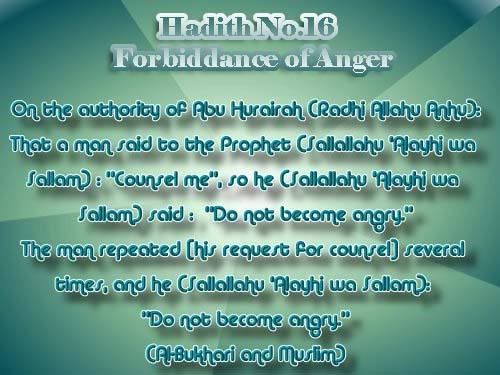
5 - Remember the advice of the Prophet: Abu Hurayrah narrated: "A man said to the Prophet: "Advise me." He said: "Do not become angry." The man repeated his request several times, and each time the Prophet said to him: "Do not become angry." ['Fath al-Bari'; 10/456]
According to another narration, the man later said: "I thought about what the Prophet said, and I realized that anger combines all kinds of evil." [Reported in the 'Musnad' of Ahmad; 5/373]
6 - Remember the high status of those who control themselves: The Messenger of Allah said: "The strong man is not the one who can overpower others. Rather, the strong man is the one who controls himself when he gets angry." [Reported in the 'Musnad' of Ahmad; 2/236, and it is authentic]
The Messenger of Allah also said: "The strongest man is the one who, when he gets angry and his face reddens and his hackles rise, is able to defeat his anger." ['Sahih al-Jami'; # 3859]
Anas bin Malik narrated "The Messenger of Allah passed by some people who were wrestling. He asked: "What is this?" They said: "So-and-so is the strongest; he can beat anybody." The Messenger of Allah then said: "Shall I not tell you who is even stronger than him? The man who, when he is mistreated by another, controls his anger, has defeated his own devil and the devil of the one who made him angry."" ['Fath al-Bari'; 10/519]
7 - Rewards for those who control their anger: The Messenger of Allah said: "Do not become angry, and Paradise is yours." ['Sahih al-Jami'; # 7374]
The Messenger of Allah said: "Whoever controls his anger at the time when he has the means to act upon it, Allah will call him before all of mankind on the Day of Resurrection, and will let him choose of the Hur al-'Ayn whoever he wants." [Reported by Abu Dawud (4777), and it is in 'Sahih al-Jami' (6518)]
8 - Remember that resisting anger is one of the signs of righteousness: {"And march forth in the way to forgiveness from your Lord, and for a Paradise as wide as the heavens and the earth, prepared for the righteous; those who spend in prosperity and in adversity, repress anger, and pardon men. Verily, Allah loves the good-doers."} [Al 'Imran; 134]
9 - Submit to reminders: Ibn 'Abbas narrated: "A man sought permission to speak to 'Umar bin al-Khattab, then he said: "O Ibn al-Khattab, you are not giving us much and you are not judging fairly between us." 'Umar was so angry that he was about to attack the man, but al-Hurr bin Qays - who was one of those present - said: "O Commander of the Believers! Allah said to His Prophet: {"Show forgiveness, enjoin what is good, and turn away from the foolish."} [al-A'raf; 199], and this man is one of the foolish." By Allah, 'Umar could go no further after al-Hurr had recited this verse to him, as he a man who was careful to adhere to the Book of Allah." ['Fath al-Bari'; 4/304]
...as opposed to how one of the hypocrites reacted when one of the Companions said to him: "Seek refuge with Allah from the Devil," So, he replied: "Do you think I am crazy? Go away!" ['Fath al-Bari'; 1/465]
10 - Remember the bad effects of anger: 'Alqamah bin Wa'il narrated: "My father said to me: "I was sitting with the Prophet, when a man came to him leading another man by a rope. He said: "O Messenger of Allah, this man killed my brother." The Messenger of Allah asked him, "Did you kill him?" He said: "Yes, I killed him." He asked: "How did you kill him?" He said: "He and I were hitting a tree to make the leaves fall for animal feed, and then he insulted me, so I struck him on the side of the head with an axe and killed him." ['Sahih Muslim'; # 1307]
Hadith #16- Restraining oneself from anger
 http://fortyhadith.iiu.edu.my/hadith16.htm
 Background
This hadith is also related by other scholars of hadith. In another narration, it is related as: A man came to the Messenger of Allah, sallallahu ‘alayhi wasallam, and said, "Messenger of Allah, teach me some words which I can live by. Do not make them too much for me, lest I forget." The Messenger of Allah, sallallahu ‘alayhi wasallam, said, "Do not be angry." [Abu Daud]
Some scholars say that the Prophet, sallallahu ‘alayhi wasallam, knew that the man who asked him used to get angry often and that is why the Prophet, sallallahu ‘alayhi wasallam, gave him that particular advice. This view may lead to narrowing down and limiting the benefit of the hadith, whereas it is very comprehensive, far-reaching and applicable to all Muslims because everyone is subject to anger.
There are other Qur'anic verses and hadith that emphasize the need to avoid getting angry. Allah mentions the qualities of the muttaqin: “Those who spend (in Allah’s cause) in prosperity and in adversity, who repress their anger, and who pardon men, verily, Allah loves the al-Muhsinun (the good-doers).” [Surah Al-Imran (3) : Ayah 133-134]
In another hadith, Abu Hurairah related that the Messenger of Allah, sallallahu ‘alayhi wasallam, said: "A strong person is not the person who throws his adversaries to the ground. A strong person is the person who contains himself when he is angry." [Al-Bukhari; Book 47, No. 47.3.12]
And from the du'a (supplications) of the Prophet, sallallahu ‘alayhi wasallam: "I ask you O Allah, for truthful speech during times of pleasure and anger" [Nasaai and Ahmad]
Lessons
There are four views, of which two of them are from the earlier scholars and the other two are from the contemporary scholars, about the interpretation of the Prophet's, sallallahu ‘alayhi wasallam, statement "Do not get angry":
1. A person should learn how to change his character and adapt the characteristics of generosity, kindness, calmness, modesty, patience and forgiving. If a person adapts these qualities, then he may be able to restrain himself when he is about to get angry.
2. One should not act based on anger or while being angry.
3. When a person is about to get angry, he should control himself, be patient and not get angry. This is a contemporary view from Sheikh Al-Bitar.
4. Ustaz Jamaluddin Zarabozo says that the text can be interpreted in the following way: a Muslim must think before acting or speaking. As soon as the feeling of anger appears to oneself, then there is a need to think of why the anger appears and whether it is necessary to be angry. While asking these questions, the person must remember Allah and the Hereafter (Akhirah). This will cause the person to calm down and not get angry.
All these interpretations can be applied as different strategies in handling anger in different situations.
If a person gets angry, then it is necessary that the person performs a muhasabah, which is to account oneself of the mistakes committed, what leads to them and how to overcome them in the future. This is an important training for us to improve ourselves.
This hadith is also related by other scholars of hadith. In another narration, it is related as: A man came to the Messenger of Allah, sallallahu ‘alayhi wasallam, and said, "Messenger of Allah, teach me some words which I can live by. Do not make them too much for me, lest I forget." The Messenger of Allah, sallallahu ‘alayhi wasallam, said, "Do not be angry." [Abu Daud]
Some scholars say that the Prophet, sallallahu ‘alayhi wasallam, knew that the man who asked him used to get angry often and that is why the Prophet, sallallahu ‘alayhi wasallam, gave him that particular advice. This view may lead to narrowing down and limiting the benefit of the hadith, whereas it is very comprehensive, far-reaching and applicable to all Muslims because everyone is subject to anger.
There are other Qur'anic verses and hadith that emphasize the need to avoid getting angry. Allah mentions the qualities of the muttaqin: “Those who spend (in Allah’s cause) in prosperity and in adversity, who repress their anger, and who pardon men, verily, Allah loves the al-Muhsinun (the good-doers).” [Surah Al-Imran (3) : Ayah 133-134]
In another hadith, Abu Hurairah related that the Messenger of Allah, sallallahu ‘alayhi wasallam, said: "A strong person is not the person who throws his adversaries to the ground. A strong person is the person who contains himself when he is angry." [Al-Bukhari; Book 47, No. 47.3.12]
And from the du'a (supplications) of the Prophet, sallallahu ‘alayhi wasallam: "I ask you O Allah, for truthful speech during times of pleasure and anger" [Nasaai and Ahmad]
Lessons
There are four views, of which two of them are from the earlier scholars and the other two are from the contemporary scholars, about the interpretation of the Prophet's, sallallahu ‘alayhi wasallam, statement "Do not get angry":
1. A person should learn how to change his character and adapt the characteristics of generosity, kindness, calmness, modesty, patience and forgiving. If a person adapts these qualities, then he may be able to restrain himself when he is about to get angry.
2. One should not act based on anger or while being angry.
3. When a person is about to get angry, he should control himself, be patient and not get angry. This is a contemporary view from Sheikh Al-Bitar.
4. Ustaz Jamaluddin Zarabozo says that the text can be interpreted in the following way: a Muslim must think before acting or speaking. As soon as the feeling of anger appears to oneself, then there is a need to think of why the anger appears and whether it is necessary to be angry. While asking these questions, the person must remember Allah and the Hereafter (Akhirah). This will cause the person to calm down and not get angry.
All these interpretations can be applied as different strategies in handling anger in different situations.
If a person gets angry, then it is necessary that the person performs a muhasabah, which is to account oneself of the mistakes committed, what leads to them and how to overcome them in the future. This is an important training for us to improve ourselves.
In various hadiths, the Prophet, sallallahu ‘alayhi wasallam, teaches us how to control our anger. For example: The Prophet, sallallahu ‘alayhi wasallam, said, "I know a word, the saying of which will cause him to relax, if he does say it. If he says: 'I seek Refuge with Allah from Satan' then all his anger will go away." [Al-Bukhari; Vol. 4, No. 502]
The Prophet, sallallahu ‘alayhi wasallam, said: "I know a phrase which, if he repeated, he could get rid of this angry feeling." They asked: "What is it, Apostle of Allah?" He replied: "He should say: 'I seek refuge in Allah from the accursed devil.'” [Abu Daud; Book 41, No. 4762]
Therefore one of the keys to controlling ourselves during anger is to seek refuge in Allah from Satan because Satan influence us through the ‘was-was’ that influence our perception. Likewise, Satan promotes evil to people by influencing their perception.
Influencing human perception as a satanic way to promote evil and create disputes among believers has been mentioned in many verses in the Qur'an, for example: "And say to My servants (that) they should (only) speak that which is the best; (Because) Shaitan verily sows dissensions among them. Surely, Shaitan is an open enemy to man." [Surah Al-Isra' (17) : Ayah 53]
Indeed, if somebody uses a vague word in his speech, then Shaitan ‘whispers’ a wrong interpretation or understanding to the listeners of the speech that may affect the relationship amongst them. This is how relationships in the family, brothers, sisters and friends are severed.
In other hadiths, the Prophet, sallallahu ‘alayhi wasallam, teaches us how to deal with anger: “Anger comes from the devil, the devil was created of fire, and fire is extinguished only with water; so when one of you becomes angry, he should perform ablution.” [Abu Daud; Book 41, No. 4766]
Abu Dharr narrated: The Apostle of Allah, sallallahu ‘alayhi wasallam, said to us: "When one of you becomes angry while standing, he should sit down. If the anger leaves him, well and good; otherwise he should lie down." [Abu Daud; Book 41, No. 4764]
In another hadith, the Prophet, sallallahu ‘alayhi wasallam, said: “If one of you becomes angry then he should be silent.”
This is an important advice because during anger, most of our actions and speech may not be correct.
Narrated 'Abdur Rahman bin Abi Bakra: Abu Bakr wrote to his son who was in Sijistan: Do not judge between two persons when you are angry, for I heard the Prophet, sallallahu ‘alayhi wasallam, saying: "A judge should not judge between two persons while he is in an angry mood." [Al-Bukhari; Vol. 9, No. 272]
This hadith is related to the previous hadith (Hadith 15) - it sets out to avoid the judge from making unjust judgment.
However, there are praiseworthy anger as known from the examples of the Prophet, sallallahu ‘alayhi wasallam. He never got angry except when the commandments of Allah are violated. However, if we want to get angry for the sake of Allah, then we need to be careful that we:
1. Are really not getting angry for ourselves or for our own interests.
2. Need to do it in the right way, like not committing wrong actions or saying vulgar words while getting angry.
3. Can achieve the benefit as intended by the shari’ah. If the action leads to more harm than benefit, then it should be avoided based on the principle of weighing between the benefits and harms.
For example, when giving advice, say it in a good way, using good words, and be careful not to get into a quarrel.
It is well known today that anger causes many health problems especially if they are not controlled. There are wisdoms behind shari’ah injunctions and here we find that to control our anger may be beneficial to our health.
Conclusion
Socially, this hadith promotes better relationship among people. We need to restrain anger and be patient. We may dislike something in this life but it may have benefits that we do not know.
Our patience towards others who have been harsh on us may later lead them to think and change themselves to be better. Muslims need to set models for others to learn from.
*~*~*~*~*~*~*~*~*~*~*
Subscribe to:
Posts (Atom)